You’re standing in front of three white Reebok sneakers — the Princess, the Club C, and the Court Advance — and they look almost identical on the shelf. Same clean silhouette, same general price range (roughly $65–$95 retail), same brand tag. So which one is actually worth buying? And if you care whether a sneaker holds its value on the secondary market — meaning resale platforms like Grailed or The RealReal, where buyers purchase used or deadstock shoes for above or below retail — the question gets more interesting. These three models have genuinely different stories once you move past the white leather exterior. One punches above its retail price for resale. One is quietly discontinued in colorways that now trade at a premium. And one is a near-perfect daily driver that doesn’t pretend to be anything other than what it is. This guide breaks down the construction differences, the value math, and exactly who should buy which shoe.
The Construction Differences That Actually Matter
Let’s start with what you’re getting inside the shoe, because the exterior is deceptively similar across all three.
Reebok Princess: Narrow Last, Long Legacy
The Reebok Princess, originally released in 1985, is built on a low-profile, flat last — the “last” being the foot-shaped mold around which the shoe is constructed, which determines silhouette and fit. The Princess uses a full-grain leather upper on its better production runs, paired with a minimal EVA midsole (EVA is ethylene-vinyl acetate, the lightweight foam material used in most casual sneaker cushioning). What’s notable here: the Princess runs narrower than the Club C, and that narrower last gives it the sleek, almost ballet-flat-adjacent profile that drove its 2023–2024 revival. Refinery29’s Reebok Princess Comeback Coverage (2024) specifically flagged construction consistency as a selling point — the shoe hasn’t been significantly redesigned in decades, which means what you’re buying in 2026 is meaningfully close to what came out in the late 1980s. The lack of redesign cycles is genuinely useful; it means fewer spec variations to navigate when shopping.
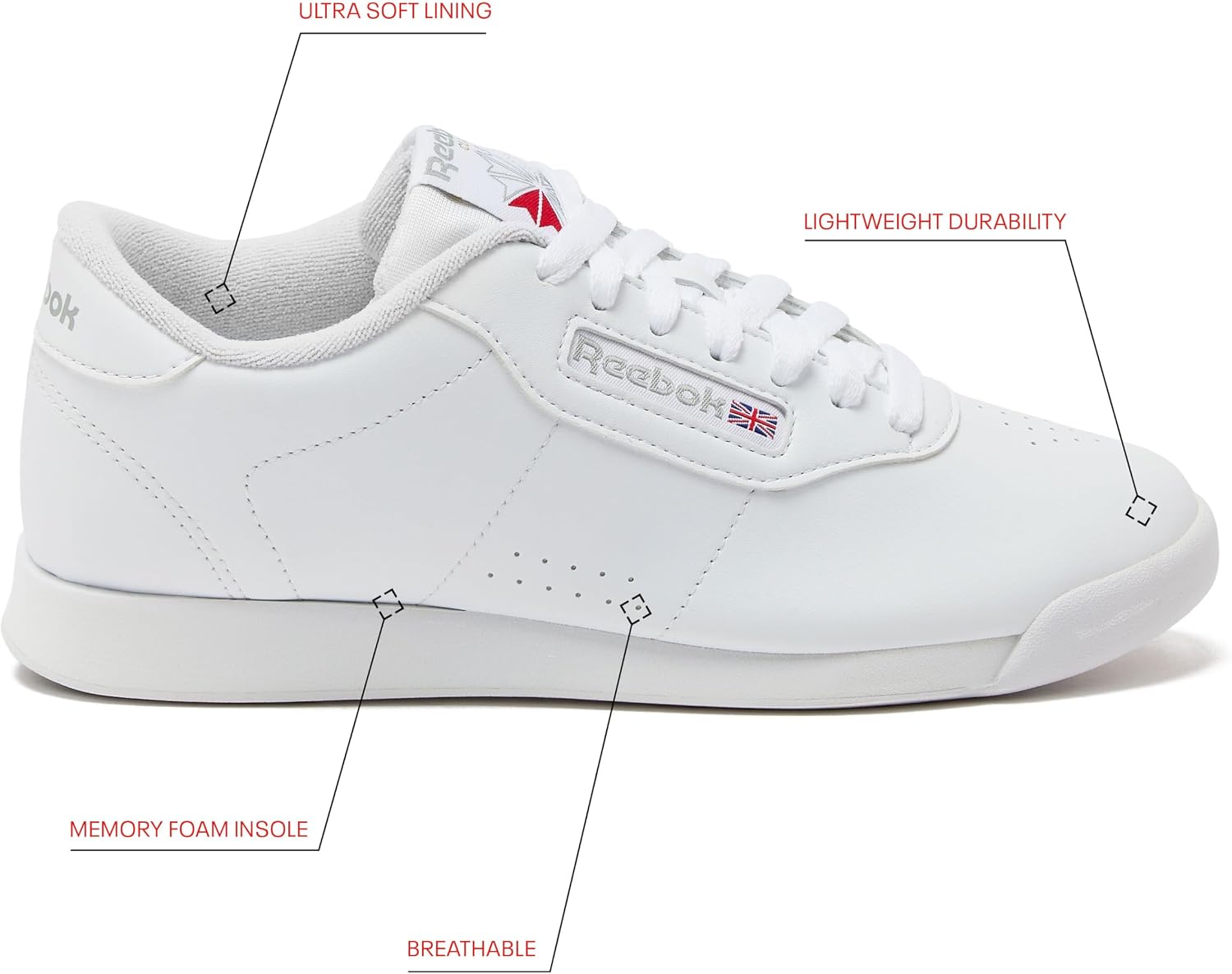
Reebok
$44.95
In stock on Amazon
Check price on AmazonClub C 85: The Most Structurally Substantial Option
The Club C 85 is the most structurally substantial of the three. It has a slightly roomier toe box, a thicker midsole with modest heel cushioning, and — on its Heritage production runs — an embossed leather upper rather than smooth. The “85” designation matters: it signals a closer-to-original spec, with a die-cut EVA sockliner and the classic terry cloth tongue lining. Who What Wear’s Best White Sneakers Ranked (2025) cited the Club C 85 specifically — not the base Club C — as the construction benchmark in this price tier, noting that the terry lining and leather quality noticeably exceed most sub-$100 competitors. If you’re buying a Club C, the “85” tag is worth seeking out deliberately. Standard Club C units in wide-box distribution use a thinner synthetic lining that reviewers across multiple publications have described as noticeably inferior. The retail price is often identical — the spec difference simply isn’t advertised on the tag.
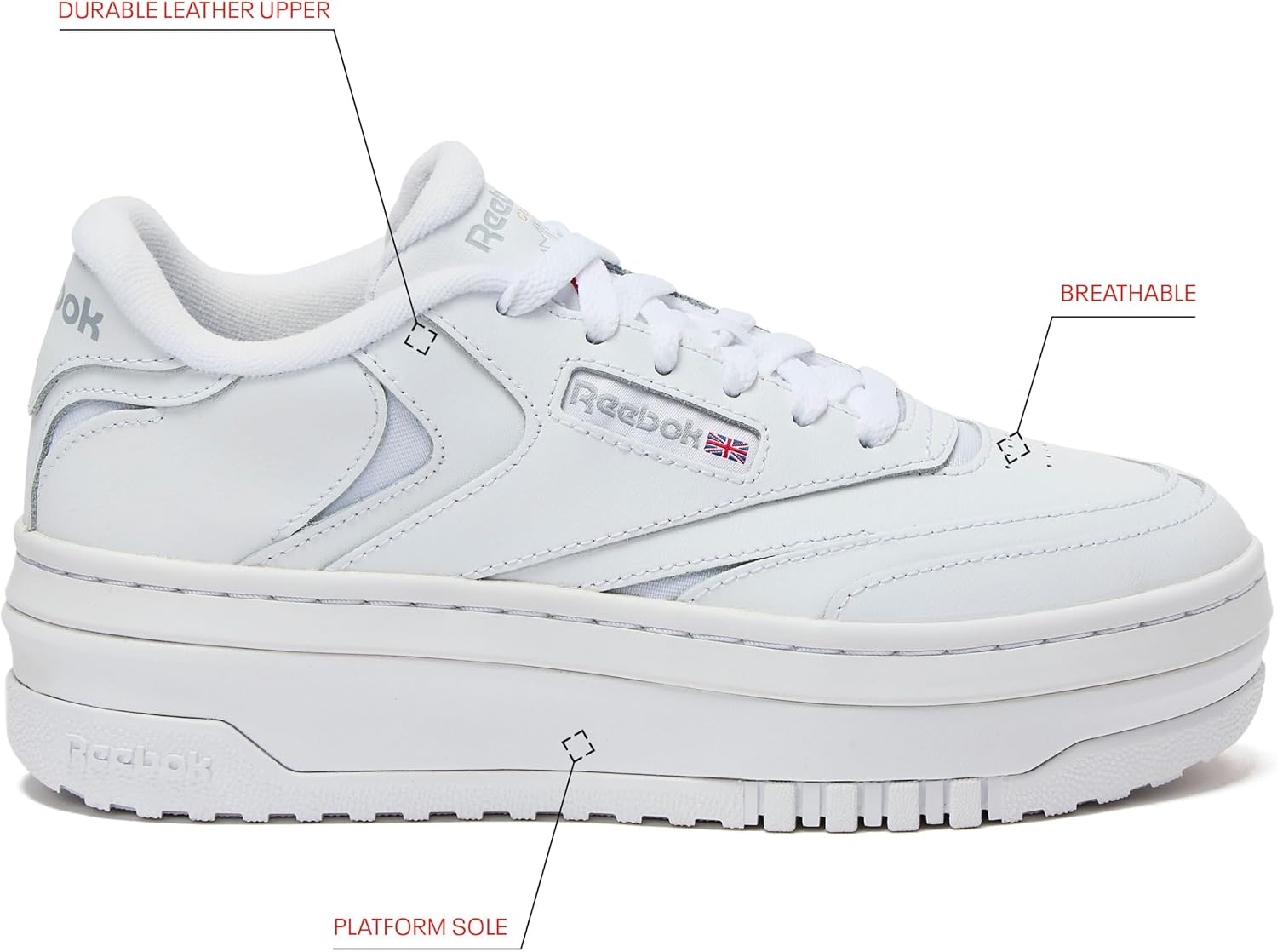
Reebok
$86.99
In stock on Amazon
Check price on AmazonCourt Advance: Cupsole Build, Immediate Comfort
The Court Advance is the youngest of the three and the least-documented in terms of long-run construction reviews. It sits visually between the Princess and Club C — slightly wider than the Princess, slightly lower-profile than the Club C — and uses a cupsole construction (meaning the midsole and outsole are one molded unit, rather than being layered separately). Cupsole builds are generally more durable underfoot and easier to clean, but they sacrifice some of the flex and break-in softness you get with the other two. Owners on aggregated review platforms consistently describe the Court Advance as the most immediately comfortable out of the box, with less of the stiff break-in period the Club C 85 requires. As the newest silhouette of the three, it hasn’t been through the spec drift the Club C has experienced, but it also doesn’t carry the manufacturing track record.
Reebok
$44.95
In stock on Amazon
Check price on AmazonResale Performance: By the Numbers
Here’s where the three models diverge sharply. Secondary market data from Grailed’s White Sneaker Secondary Market Data (2025) and The RealReal’s Sneaker Resale Trend Report (2025) inform the figures below.
Club C 85: Solid Floor, Real Ceiling on Limited Runs
Standard Club C 85 colorways trade at or slightly below retail on the secondary market — which is actually a sign of a healthy, widely available product rather than a collector item. Common white-on-white pairs typically move between $70 and $85 on Grailed, compared to an $85–$90 retail entry point. The upside is in collaboration and limited-edition runs: Hypebeast’s Reebok Brand Heritage Overview (2024) documented a consistent cadence of Club C 85 collaborations that regularly reach $120–$180 on secondary market. If you’re buying a standard Club C 85 in white, plan to wear it, not flip it. If you’re acquiring a limited run at retail, the calculus changes meaningfully.
Reebok
$86.99
In stock on Amazon
Check price on AmazonReebok Princess: Above-Retail Resale Without Traditional Hype
The Princess resale premium deserves unpacking. The shoe’s secondary market strength isn’t driven by hype in the traditional sneaker-collector sense — there are no Princess collaborations generating the kind of heat a limited athletic-brand drop does. Instead, the premium is driven by scarcity mechanics. Reebok, now operating under Authentic Brands Group ownership — a structural shift that Business of Fashion’s Authentic Brands Group / Reebok Acquisition Analysis (2022–2025) has tracked closely — has run the Princess in limited production windows, creating genuine deadstock gaps in the market. Select colorways of the current Princess move between $75 and $110 on Grailed, above the $65–$75 retail price. Vintage 1980s and 1990s pairs in wearable condition command $130–$200 or more on The RealReal depending on colorway and condition grade, per The RealReal’s Sneaker Resale Trend Report (2025). This is nostalgia-and-scarcity pricing, not hype pricing — but the outcome for sellers is similar.
Reebok
$44.95
In stock on Amazon
Check price on AmazonCourt Advance: An Honest Underperformer for Resale
The Court Advance is a good shoe that is also widely available, mid-cycle in its product life, and without a legacy narrative driving secondary demand. Grailed’s White Sneaker Secondary Market Data (2025) shows most Court Advance listings moving at roughly 10–20% below retail. Most pairs in standard colorways sell between $55 and $75 against a $75–$95 retail price. There is no current secondary market ceiling worth planning around. If you’re buying a Court Advance, you’re buying it to wear — and that’s a completely legitimate reason to buy a sneaker.
Reebok
$44.95
In stock on Amazon
Check price on AmazonComparison Snapshot: Secondary Market at a Glance
| Model | Retail (USD) | Avg. Resale — Common Colorways | Premium / Deadstock Ceiling |
|---|---|---|---|
| Club C 85 Heritage | $85–$90 | $70–$85 | $120–$180+ (collab / limited) |
| Reebok Princess | $65–$75 | $75–$110 (above retail on select) | $130–$200 (vintage / NOS) |
| Court Advance | $75–$95 | $55–$75 | $80–$100 |
NOS = new old stock, meaning unworn pairs from discontinued production runs. Data aggregated from Grailed White Sneaker Secondary Market Data (2025) and The RealReal Sneaker Resale Trend Report (2025).
Fit and Sizing: What You’ll Actually Feel
Construction quality that doesn’t fit isn’t value — it’s a shelf piece. The three models diverge meaningfully here.
Princess Fit: Narrow and Uncompromising
The Princess runs narrow and true to size. If you have wider feet or a high instep, size up half a size. The narrow last is the design, not a flaw — it’s load-bearing to the shoe’s aesthetic identity. Who What Wear’s Best White Sneakers Ranked (2025) consistently describes the Princess as the most feminine-silhouette option in this comparison, and that shape is a feature, not a manufacturing shortcut. Buyers who fight the last rather than work with it usually end up unhappy with the shoe regardless of how it performs on the secondary market.
Reebok
$44.95
In stock on Amazon
Check price on AmazonClub C 85 Fit: Roomy Toe Box, Slightly Wide
The Club C 85 runs slightly wide and true to size for most foot shapes. The roomier toe box is comfortable for all-day wear and accommodates wider feet better than the Princess. Owners with narrow feet sometimes report the shoe feeling slightly sloppy — half sizing down is the common workaround, but Reebok’s half-size availability varies by colorway and retailer. The stiff break-in period is real: most owners report the first week of wear feeling noticeably firm, after which the leather softens into a comfortable fit. Plan for that break-in window rather than treating it as a defect.
Reebok
$86.99
In stock on Amazon
Check price on AmazonCourt Advance Fit: Neutral and Low-Risk
The Court Advance runs true to size with a medium-width fit. It generates the fewest fit complaints in aggregated review coverage and the fewest “size up / size down” recommendations of the three models. If you’re buying blind — as a gift, or online without trying on — this is the lowest-risk fit of the three. The cupsole construction also means there’s minimal break-in friction; comfort is immediate rather than earned.
Reebok
$44.95
In stock on Amazon
Check price on AmazonThe Decision Framework: Who Should Buy Which Shoe
You’ve read the construction breakdown and the resale math. Here is the honest “if X, then Y” of it.
If you care primarily about resale upside: The Princess is your play — but only on select colorways or deadstock pairs, and only if you understand the market is driven by scarcity and nostalgia rather than traditional sneaker hype. Common colorways do not reliably move above retail. Do your research on Grailed before buying, not after.
If you want the best construction and wearability in this price range and aren’t buying for resale: The Club C 85 Heritage spec is the right answer. It is the most substantive shoe of the three, it carries the deepest legacy, and the material quality difference between the Heritage run and the standard version is meaningful enough to be worth seeking out the right retailer. Expect a break-in period — the first week is stiff, then it softens into one of the better casual sneakers available at this price point.
If you want the easiest, most immediate wear with the least friction and have no interest in resale: The Court Advance is genuinely good. It is comfortable immediately, fits a wide range of foot shapes neutrally, and cleans well thanks to the cupsole construction. Go in knowing you are not building secondary market equity — and decide whether that matters to you.
If you’re buying a gift and cannot guarantee fit: Court Advance, half a size up from the recipient’s usual size, with the receipt retained. Lowest fit-failure risk of the three by a meaningful margin.
One tradeoff worth naming explicitly: the Princess has the best resale story and the most interesting legacy, but it is also the most fit-specific shoe of the three. If the narrow last does not work for your foot, no amount of secondary market upside makes it the right purchase.
The Reebok classics category is genuinely crowded right now, and all three of these shoes are real products worth owning. The mistake is treating them as interchangeable just because they share a brand name and a color palette. They are solving different problems — and now you know which one is solving yours.