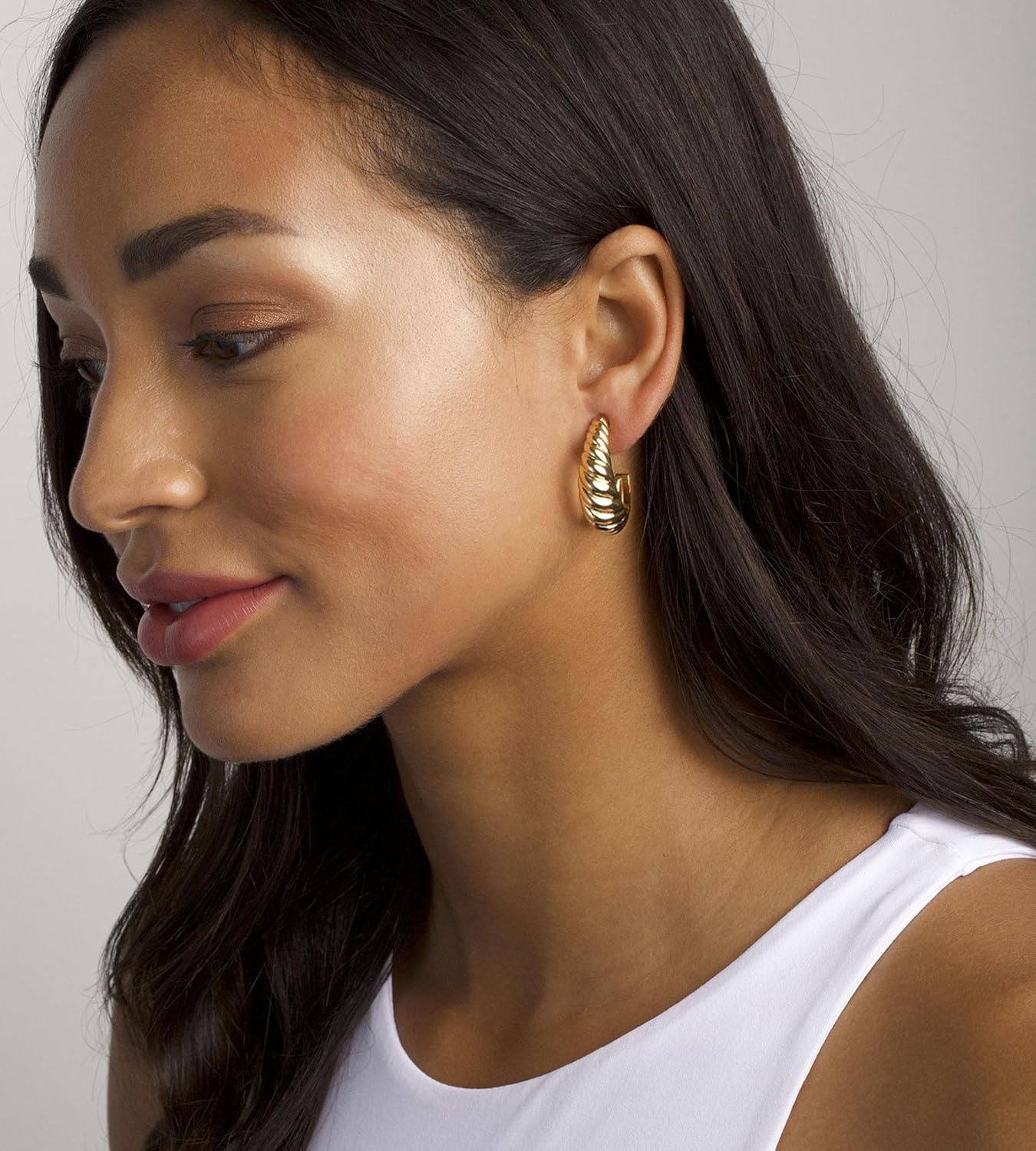
You’ve bought a set of gold hoops before. They looked exactly right in the product photos — warm, substantial, the kind of everyday earring that anchors a whole look. Six weeks later, the spot where the hoop rests against your earlobe has gone dull. A month after that, there’s a faint green ring on your skin. That’s not bad luck; that’s a plating problem. And the frustrating part is that the listing probably called them “gold” the whole time — which is technically accurate, in the same way calling a paper cup “dishware” is technically accurate. Gold plating is a finishing process where a very thin layer of gold is applied over a base metal (the core material underneath, usually brass, copper, or steel). The thickness of that layer, and what’s underneath it, determines almost everything about how long your earrings will hold their finish — and whether they’ll ever turn on you.
This guide is for the shopper who already understands that price isn’t the only signal, and who wants to know exactly what to look for in a product description before committing. We’ll walk through the terminology, the numbers that actually matter, and the decision framework that separates a set worth buying from one worth skipping.
| EDITOR'S PICK53 Pairs Earrings Set for Women | Mid-tier[Angelady Gold Hoop Earrings Set](https://www.amazon.com/dp/B0DFLJHNDK?tag=greenflower20-20)… | Budget pick[IFKM 24 Pairs Gold Hoop Earring](https://www.amazon.com/dp/B0C2BM92C4?tag=greenflower20-20)… | |
|---|---|---|---|
| Plating type | — | 14K Gold Plated | — |
| Hoops count | 53 | — | 24 |
| Material | Acrylic | — | — |
| Styles included | Tassel, Pearl, Drop Dangle | Flower, Moon, Cross, Huggie | Chunky Chain, Twisted Open, Dangle |
| Price | $18.98 | $14.23 | $9.97 |
| See on Amazon → | See on Amazon → | See on Amazon → |
The Three Categories You’re Actually Choosing Between
When a listing says “gold,” it could mean at least four different things. Harper’s Bazaar’s breakdown of gold jewelry terminology is one of the clearest available primers, and it draws the same essential distinctions most jewelers use:
Gold-plated is the baseline and the most common. A base metal — frequently brass or copper — is electroplated with a layer of gold. The industry standard for calling something gold-plated is a minimum of 0.5 microns of gold thickness. Budget fashion jewelry often comes in far below that, in the 0.05–0.3 micron range, which is where green-skin situations originate. At that thickness, the gold layer wears through in weeks of regular contact with skin oils, sweat, and water.
Gold vermeil (pronounced “ver-MAY”) is a specific legal standard in the United States: at least 2.5 microns of gold over sterling silver (925 silver), with a minimum gold purity of 10 karats. Because the base metal is silver rather than copper or brass, vermeil earrings that do eventually wear through won’t produce the same green-skin reaction — silver oxidizes differently. Vogue’s explainer on gold-filled versus gold-plated jewelry confirms that vermeil is effectively the minimum tier worth recommending for everyday wear.
Gold-filled is a step above vermeil in durability. Here, a layer of gold alloy is mechanically bonded to a brass core under heat and pressure — the gold layer must constitute at least 1/20th (5%) of the item’s total weight by US standards. That’s not a plating; it’s a thick cladding. Gold-filled hoops can last decades with reasonable care and won’t typically tarnish in a normal jewelry-wearing lifetime.
Solid gold (10k, 14k, 18k) needs no elaboration here — it’s the material all the way through. For everyday hoop sets, solid 14k is the practical ceiling for most shoppers; 18k is softer and scratches more easily, which matters less for a simple hoop than for a ring.
The Numbers That Separate a Good Plating from a Bad One
Here’s the condensed math that determines whether you’re buying something that lasts.
By the numbers:
- < 0.5 microns: Fashion-grade plating. Expect 1–6 months before visible wear under daily use.
- 0.5–1.0 microns: Entry commercial standard. Reasonable for occasional wear; not daily.
- 2.5 microns: US vermeil minimum. The lowest threshold at which “everyday earring” is a fair claim.
- ≥ 5 microns (gold-filled equivalent): Long-term wear tier. What fine jewelry brands use as their baseline.
The second number that matters is the base metal. Copper and brass both react with skin moisture to produce copper salts — that’s the green residue. Brass is a copper-zinc alloy, so it does the same thing. Sterling silver underneath is inert in that reaction. This is why two earrings with identical plating thickness can have dramatically different green-skin outcomes depending on what’s underneath.
A third variable that most listings won’t tell you is alloy composition of the gold layer itself. Pure gold (24k) doesn’t tarnish, but it’s too soft to plate effectively and too expensive to use in fashion jewelry. Most plated pieces use 14k gold alloy in the plating layer, which contains copper and silver alongside the gold. Lower-karat alloys tarnish faster. A listing that says “18k gold plated” isn’t necessarily lying — but it also isn’t telling you about the thickness or the base metal.
Refinery29’s reporting on why gold jewelry turns green specifically calls out the combination of thin plating over high-copper base metals as the dominant cause of discoloration complaints, noting that moisture accelerates the process significantly.
How to Read a Product Listing Without Getting Burned
You’re looking at a gold hoop set on Shopbop, SSENSE, or a brand’s own site. Here’s how to extract what actually matters:
Step 1: Find the micron count. Any brand confident in their plating will publish it. If the listing says “gold-plated” with no thickness number, assume the minimum (sub-1 micron). If it says “heavily plated” or “thick plating” without a number, that’s marketing language, not a spec.
Step 2: Identify the base metal. Look for “base: sterling silver” (the vermeil indicator), “base: brass,” or “base: surgical steel.” Surgical or medical-grade steel (316L stainless) is a reasonable base for post earrings because it doesn’t react with skin — stainless hoops with decent plating outperform brass hoops with the same plating in wear tests by independent reviewers.
Step 3: Check for vermeil or gold-filled labeling. These terms have legal definitions in the US and represent a floor of accountability. A brand that says “gold vermeil” is committing to the 2.5-micron, sterling-silver standard. A brand that just says “gold-plated” is not.
Step 4: Look at the care instructions. This is an underused signal. A brand selling genuinely durable plating will tell you the piece is water-resistant or safe for daily wear. A brand selling thin plating will tell you to keep it away from water, perfume, and lotion — because they know what happens when you don’t.
Step 5: Assess the price against the tier. Gold-filled hoops from a direct-to-consumer brand typically land in the $40–$90 range for a simple set. Solid 14k sets start around $80–$120 at smaller brands, higher at heritage names. If you’re seeing a “gold-filled” or “14k” claim at $12 for a set of five hoops, one of those claims isn’t accurate. Business of Fashion’s reporting on fine jewelry economics notes that the material cost alone for a gold-filled hoop set puts a realistic floor on pricing — undercutting it significantly means something in the claim chain is soft.
Where Specific Brands and Tiers Land
This isn’t a ranked list — it’s a framework check against recognizable names.
Budget tier ($10–$30 sets): Most of what’s in this range is fashion-plated brass or base metal. Fine for a trend piece you’ll wear twice. Not a daily driver. Who What Wear’s roundup of gold hoop earrings across price points consistently notes that sub-$30 options work as styling tools, not investment pieces.
Mid tier ($35–$80 sets): This is where vermeil and gold-filled genuinely appear. Brands like Mejuri, Aurate, and Missoma have built their positioning around transparent plating specs — Mejuri publishes micron counts on their vermeil pieces, which is an industry rarity and a strong trust signal. At this tier, you’re buying something you can wear daily without babying it, provided you follow the care instructions.
Premium fine jewelry tier ($100–$300+): At this price point, the expectation is solid 14k or heavy gold-fill on sterling. Brands like Catbird and Wwake operate here. The earrings become jewelry-box pieces rather than drawer pieces — you care for them accordingly.
Sets specifically: Multi-hoop sets (the 3-pack or 5-pack format) complicate the math because you’re getting multiple sizes for a single price. The tradeoff is usually that smaller hoops in the set are thinner-gauge wire — which means less plating coverage per piece and faster wear at the stress points (where the hoop opens and closes). Reviewers across aggregated feedback on mid-tier set purchases consistently note that the large statement hoop in the set holds up longer than the tiny ear-cuff or huggie pieces.
The Decision Rule
Here’s the if/then framework:
If you want everyday hoops you don’t think about: Buy gold vermeil (2.5 microns, sterling base) at minimum, or gold-filled if your budget allows. Expect to spend $40–$80 for a quality mid-tier set. Skip anything without a published thickness or base-metal spec at that price point.
If you want a trend set for a season or two: Fashion-plated brass at $15–$25 is a rational choice — just go in knowing what you’re buying. Keep them away from water and perfume and they’ll hold longer.
If you’re building a permanent stack: Solid 14k for the pieces you’ll wear every day, vermeil for the ones you rotate. The economics favor buying fewer, better pieces rather than replacing budget sets annually.
If your skin reacts to metals: Prioritize the base metal over the plating tier. Surgical steel or sterling silver underneath is the relevant variable, not gold purity. Harper’s Bazaar’s guide to hypoallergenic jewelry specifically flags that nickel in low-quality brass alloys is the most common contact allergen — and nickel content is rarely disclosed in fashion jewelry listings.
The green-skin problem is almost always preventable. It just requires knowing which questions to ask before the purchase, not after the earring leaves a mark.