You’ve seen them everywhere — those large, woven hoop earrings with a warm, honey-brown texture that somehow look expensive even when they cost twelve dollars. They’re called rattan earrings, named after rattan (a palm-derived natural plant fiber used in furniture and home goods for centuries), and they became a genuine wardrobe staple because they pair with almost anything: linen, denim, a plain white dress. The problem is that most of what’s being sold right now isn’t rattan at all. It’s acrylic — a type of lightweight plastic — molded and printed to mimic the woven texture of the real thing. Both sit on the same shelf, share similar price tags at the entry level, and photograph identically. But put them side by side after six months of regular wear, and the difference is obvious. This guide breaks down exactly what separates them, how durability plays out across budget, mid-tier, and premium price points, and how to make a confident call before you spend.
What “Rattan” Actually Means in Jewelry (and How Brands Use the Word Loosely)
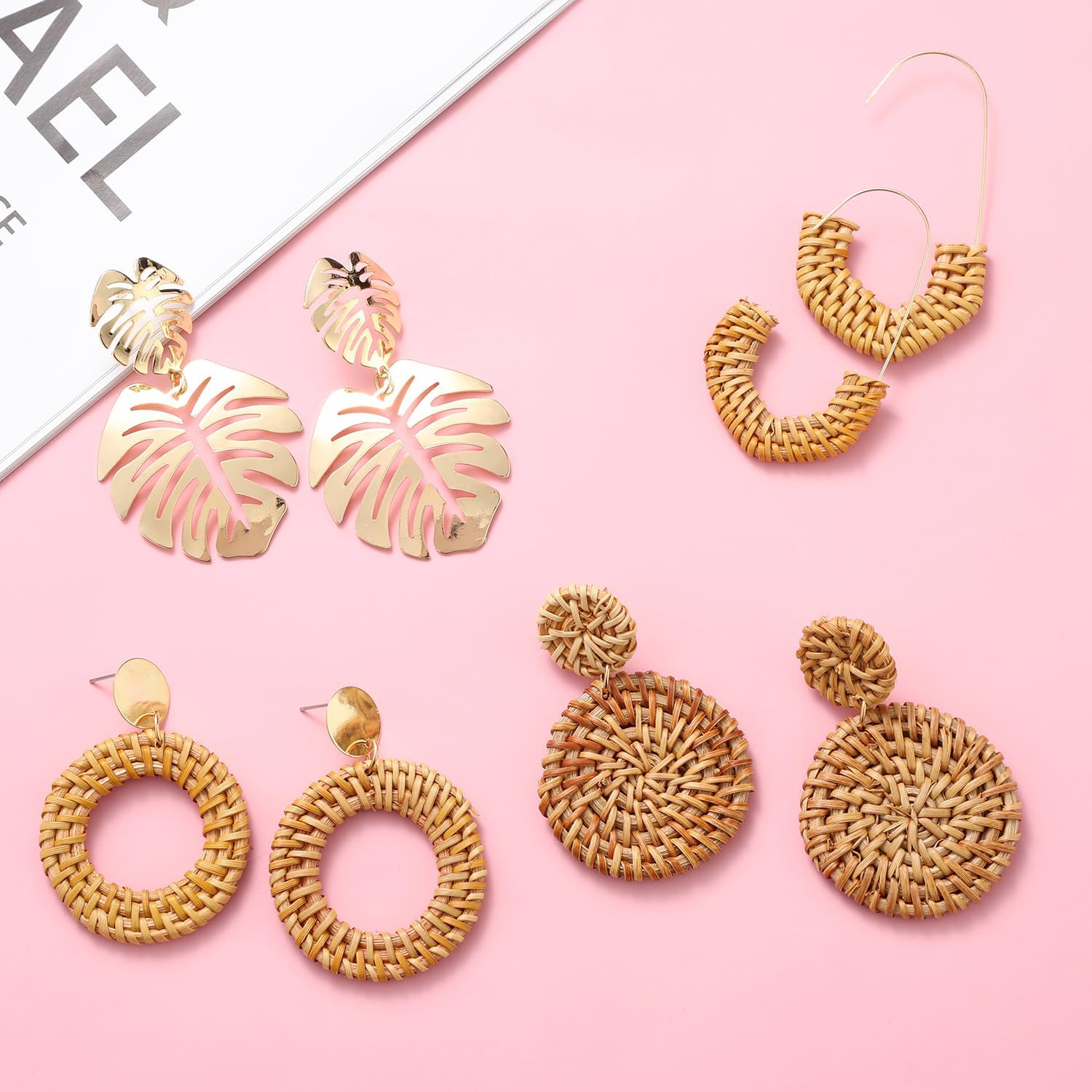
Rattan, the material, is harvested from climbing palms native to tropical Asia and Africa. As a furniture and craft material, it’s been documented in trade records going back to the 17th century — it’s light, strong, and takes dye well. In its earring form, genuine rattan is typically hand-woven or wrapped around a wire or resin base, then lacquered or left raw. The weave has irregular variation — no two pieces are identical — and it carries a faint organic smell before lacquering.
The problem is that “rattan” has become a style descriptor rather than a material one. As documented in Who What Wear’s “The Best Rattan Earrings of 2025,” brands routinely use the word to describe look-alike products made from acrylic, MDF composite, or resin pressed into a woven-texture mold. None of this is technically illegal — “rattan-style” is a style category, not a regulated material claim — but it does mean you can’t trust the product title alone.
What you can trust: the weight, the price-per-gram, and the construction details. The following sections walk through each tier of the market with that lens applied.
The Four Ways to Tell Them Apart Before You Buy
1. Weight differential
Genuine rattan is lighter than acrylic of the same apparent volume. This matters practically: a 3-inch rattan hoop sits differently on the earlobe than an acrylic imitation of similar size. For earrings larger than roughly 2 inches in diameter, weight is a legitimate daily-wear variable — not just a material trivia point. Ear fatigue accumulates with mass over a full day.
2. Surface consistency
Acrylic molds produce a perfectly uniform texture. Every “weave” intersection is identical, every groove the same depth. Genuine rattan has slight irregularities — variations in strand width, the occasional gap, color tonal shifts across the surface. Harper’s Bazaar’s “Natural vs. Synthetic Jewelry Materials” (2024) confirms that hand-crafted natural fiber pieces will always show some surface variation, and that this is a marker of authenticity rather than a quality defect.
3. Price floor
Here’s the honest economics: genuine rattan earrings at the entry level start around $18–$28. Below that, you’re almost certainly looking at acrylic or composite. The material cost and hand-finishing labor required to produce real rattan pieces make sub-$15 pricing essentially impossible at any sustainable margin. Acrylic injection molding, by contrast, produces at scale and at cost fractions of raw fiber. If you’re seeing “rattan” earrings at $8–$12, treat that as a category signal that the material description is aspirational.
4. Lacquer vs. plastic sheen
Natural rattan is typically finished with a clear lacquer that sits on top of the material. It has a matte-to-satin surface. Acrylic inherently has a shinier, more uniform reflective quality even when manufacturers add a matte coating — the light bounce is different. This is easier to see in person than in product photography, which is one reason online shopping for this category is genuinely harder than in-store evaluation.
Durability by Price Tier: Where Each Material Fails and When
This is the practitioner question — not whether the difference is real, but when it shows up and how. The comparison below is organized by the three purchase tiers where real decisions get made.
Budget Tier: Under $20
At this price point, you are buying acrylic. That’s not a criticism — it’s a category fact. Acrylic injection molding produces consistent, lightweight pieces at margins that allow $8–$18 retail pricing. The pieces photograph well, arrive quickly from high-volume sellers, and are widely available.
The failure mode to plan around: UV yellowing and surface cracking. Acrylic is sensitive to prolonged sun exposure and to extreme temperature shifts — left in a car, stored near a sunny window, or worn daily through a humid summer. The material develops micro-cracks that catch moisture, then visibly yellows or turns opaque over time. Refinery29’s “Earrings Under $30 That Actually Hold Up” (2025) notes that plastic-based fashion earrings in this category tend to show visible aging within a single season of daily wear in warm climates.
Recommended use case: travel, festivals, events where loss or damage is likely, or testing a silhouette before committing to a better version.
 product image](/images/external/957eb54c111d.jpg)
Ponpon
$9.99
In stock on Amazon
Check price on AmazonMid-Tier: $20–$45
This is the most complicated band in the category, and where the most purchasing mistakes happen. The $20–$45 range contains both genuine natural-fiber earrings from smaller artisan producers and premium-packaged acrylic from mid-tier fashion brands — and the product titles often use identical language.
The signal to look for at this tier is specificity in the product description. A brand that tells you the weave is hand-finished, that the backing is brass, and that the fiber is sourced from a named region is selling something categorically different from a brand that calls its product “rattan-inspired” without further detail. Who What Wear’s “The Best Rattan Earrings of 2025” draws exactly this distinction in its editorial evaluation criteria: construction transparency is treated as a proxy for material authenticity.
Natural rattan pieces in this range will outlast their acrylic counterparts by a meaningful margin when worn in temperate, low-humidity conditions — but they carry their own failure mode: sustained moisture. Sweat, humidity, and direct water exposure cause natural fiber strands to swell, loosen, and eventually de-laminate from the base. This is slower-onset than acrylic yellowing but equally irreversible.
Recommended use case: regular weekly rotation in temperate climates; wardrobe investment pieces where the $30–$45 marginal cost over budget alternatives is justified by expected wear cycle.
16
$16.99
In stock on Amazon
Check price on AmazonPremium Tier: $45 and Above
Above $45, the category bifurcates clearly. Small artisan brands selling through higher-end retail channels at $45–$90 typically produce genuine natural-fiber pieces with documented sourcing — their product pages describe construction in detail because that’s their value proposition, not an afterthought. The weave variation is visible and intentional. The hardware (ear wire, backing) tends to be sterling or gold-filled rather than base metal. These are pieces built for 2–4 years of regular wear.
Vogue’s “The Accessories That Define the New Bohemian” (2024) positioned rattan earrings specifically as having moved from trend artifact into perennial category — repositioned alongside bamboo jewelry and shell pieces as a year-round natural-materials story. That assessment has direct implications for buyers at this tier: you’re purchasing into a stable aesthetic, not a micro-trend with a 12-month expiration.
The secondary market adds another variable at this price point. The RealReal’s Jewelry Resale Trend Report (2025) noted that handcrafted natural-fiber jewelry from named artisan brands carries meaningful resale demand — not at the same velocity as fine metals, but consistently above zero. Acrylic fashion earrings, regardless of original brand or price point, have essentially no secondary market value. This doesn’t change the calculus for a $15 pair, but it shifts the math meaningfully at $45–$90: you’re buying something that holds nominal secondary value versus something that doesn’t.
Recommended use case: daily or near-daily rotation over multiple years; gift purchasing where longevity signals intent; buyers who prioritize comfort on long wear days (the weight advantage of natural fiber compounds over time).

18
$17.99
In stock on Amazon
Check price on AmazonThe Full Comparison at a Glance
| Condition | Natural rattan | Acrylic imitation |
|---|---|---|
| UV / sun exposure | Minimal effect (lacquer helps) | Yellows in 12–18 months |
| Humidity / sweat | Swelling, de-lamination risk | No effect |
| Impact / drop | Surface crack possible | Shatters or chips |
| Surface texture | Irregular, hand-variable | Perfectly uniform |
| Typical lifespan (regular wear) | 2–4 years | 8–18 months |
| Secondary market value | Nominal but present | Essentially zero |
The Decision Frame: Which Version Should You Buy?
If you’re approaching this as a practitioner — someone building a wardrobe with intention rather than just filling gaps — the decision reduces to a few honest variables.
Buy acrylic if:
- Your budget ceiling for earrings in this category is under $18
- You’re buying for a specific event, trip, or short-season use
- You want to test whether you’ll actually wear this silhouette before committing money to a better version
- The climate you’re wearing them in is consistently humid
Buy natural rattan if:
- You’re planning regular rotation (weekly or more) across a year or more
- You care about comfort over long wear days — the weight difference adds up over hours
- You want something that won’t visibly age into a disposable look within a year
- You’re at the $30+ price point anyway and the marginal cost of real material is small relative to total spend
The threshold worth marking: around $30–$35, the category bifurcates clearly. Below it, almost everything is acrylic with rattan styling vocabulary. Above it, you start finding genuine natural fiber construction from small brands and artisan producers. At that range, it’s worth reading the full materials section in the product description, looking for seller confirmation of “natural rattan” versus “rattan-style” language, and checking whether the brand has a construction story at all. Specificity in the product description is the clearest quality proxy available to an online buyer.
The Practical Bottom Line
Rattan earrings are a genuinely useful category — lightweight, seasonally flexible, strong on outfit versatility — but “rattan” as a product label is unreliable. The real material split happens around the $30 price floor, shows up visually in surface regularity and sheen, and plays out in durability across a 12–24 month wear cycle. Acrylic versions aren’t fraudulent — they’re a legitimate choice for low-commitment purchasing — but they’re not the same product, and paying $45 for one when you could have the other is the kind of inefficiency that compounds quietly over time. Know which one you’re buying, and buy it on purpose.